
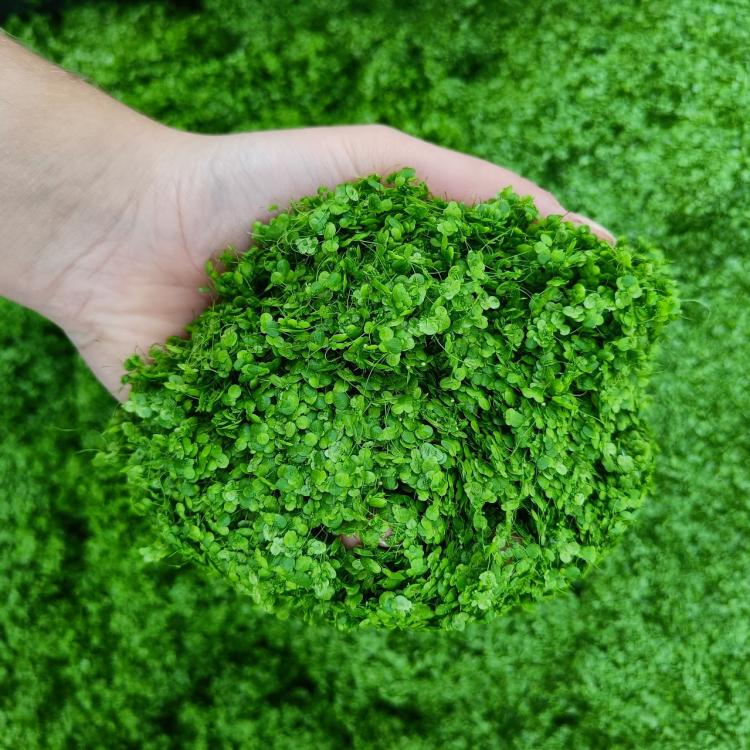
Based on the crude protein content fresh Lemna could have a value between € 0.19/kg and € 0.28/kg for 27% and 40% protein duckweed respectively, for 1 kilo of dry matter of fresh duckweed (18 kilos of fresh weight).
When measuring the biodigestibility of the protein for dairy cattle specifically, both 27% and 40% protein content duckweed had similar results, and a feed value calculated as € 0.22/kg, which could probably be raised due to the organic nature and mineral content of duckweed feed.
These costs are per dry kilo of fresh duckweed, but commercial drying costs are often over € 3.25/kg of dried product, so it's important to focus on inclusion of fresh duckweed as 0-20% of the feed depending on the species.
Feed formulators consider several factors when buying an animal feed ingredient, and when looking at the composition of duckweed would evaluate its protein content, mineral content, and organic status. when negotiating a price.
The world market price for soybean meal “Argentine 45/46%” averaged 316 ± 10 € per ton FW between June 2019 and 2020 (Indexmundi, 2021). This product has a protein content of approximately 45%. The concentration corresponds to a protein price of 702 € per ton protein. In Flanders dairy cattle feed's are measured based on their FUM and DVE, measurements of protein amino acid profile, and what % is found in the cow small intestine. Surprisingly less fertilized duckweed with 27% crude protein and duckweed grown on swine effluent with 40% protein content had very similar FUMs and DVEs.
Using crude protein content the value was determined to be € 0.19/kg for 27% protein duckweed, and € 0.28/kg for 40% protein duckweed, for 1 kilo of dry matter of fresh duckweed (18 kilos of fresh weight). Cowdashboard.com calculated the feed value of a harvest of a crop based on a proprietary formula using FUM and DVE, and the duckweed samples had a calculated value of € 0.216/kg.
Besides protein, a feed ingredient consists of other elements. Replacing the protein of soybean meal with that of duckweed influences the mixture concentrations of the other elements as well. Duckweed's high ash fraction can be a source of minerals such as Mn, Zn, and Fe. For example, in conventional pig farms, zinc supplements are given to prevent claw problems (Van Riet 2015). Feed rations calculators consider these substitutions.
Furthermore, duckweed can be preferred over other feed ingredients because it can meet several criteria within existing labels such as ‘bio’ or ‘VLOG’. When the requirements of a label are met, the product can be branded under the label. The potential extra cost needed to meet these requirements is generally compensated with the higher selling price. A potential existing label is VLOG milk (Verband Lebensmittel Ohne Gentechnik). Flemish farmers can sell their dairy milk on the German market with the VLOG label if they only use feed ingredients that are not genetically modified organisms (GMOs) or contaminated with genetically modified organisms (VILT, 2018).
Taking the above-mentioned aspects into consideration, the feed value was chosen to be 0.22 € kg-1 DW in the analysis.