
In summary, farmers currently pay to have manure treated at a facility for € 21/m3, sediment and spread manure for € 5.5/m3 until they reach the legal limit of applied nitrogen, and potentially rely on a settling lagoon to anaerobically digest some BOD to reduce the volume of sludge to spread. A duckweed lagoon acts as a settling lagoon, outperforming the first two options, and improving the nitrogen and phosphorous removal compared to a sedimentation lagoon. While the price of the feed is a small fraction of the treatment benefit, it's important to have a use for the duckweed before you start producing tons per year. A full picture of the pig case study can be found in the sheet of the economic models, and the accompanying report.
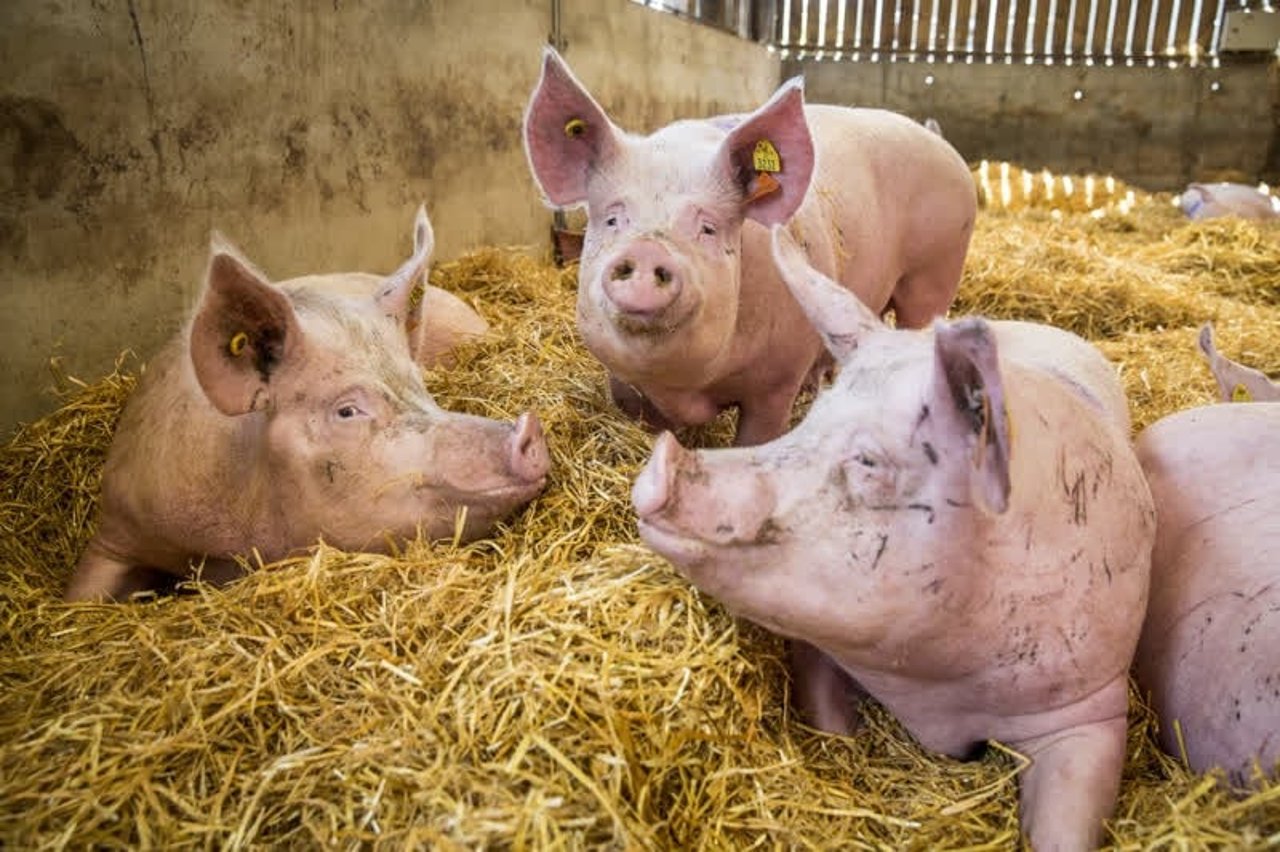
Flanders has a high concentration of family-owned pig farms, with some breeding their own piglets, and others purchasing them, and growing them to market weight. About two thirds of these fattening farms have more than 1500 pig places, or stalls, which about 2 pigs per year will cycle in and out of (statbel.f.gov). Our case study detailed in the Pig Case Study sheet of the workbook will assume a theoretical farmer named Jan, has a 1500 stall pig fattening farm, with the manure processing setup above. Each stall will produce 1.2 tonnnes, or 1.2 m3 of manure a year (CBS 2012). Assuming that 50% of the 1,800 m3 of manure produced in a year can be sedimented in a storage tank, and spread on nearby fields until N application maxima are met, and that the remaining 9,000 m3 need to be taken to a manure processor, Jan’s treatment costs with minimal manure processing would be €23,850/year.
After settling in the storage tank, each m3 of manure will produce 0.83 m3 of biological effluent, BE, (1 pig place =1,200 m3 manure/year = 996 m3 BE/year) (Corbala-Robles et al. 2018), so Jan enters the wastewater stream of 1,800 m3 of manure into the calculator as 1,494 m3 of Swine lagoon effluent, which can be looked up in the dropdown menu to provide measured levels of NPK and other nutrients, and TSS and COD level estimates of multiple measured example wastewater streams. While Jan’s values were very close to the example, he slightly lowered TSS in the column where you enter wastewater test results to customize the treatment calculator. When asked about storage or a biogas reactor, he selected YES, since his onsite manure storage, could be used to sediment, and store manure through the winter, and increase flow rates during the summer, substantially boosting the performance of duckweed treatment ponds. If a farmer is does not have a storage tank, settling lagoon, or biogas reactor, we’d strongly recommend one, preferably a biogas reactor to settle TSS along with many nutrients cost effectively, improve the efficiency of other duckweed treatment lagoons, and capture and utilize CH4 and NH3 gasses, planning ahead of potential treatment regulations when designing systems with 10-20 year lifespans.
With a flow rate of 1494 m3/year Jan selects the high range of HRT as 10 days since he’s relatively land limited, and expects to be increasing his flow rate during the summer to make up for his winter storage. Based on the input volume, concentration of each nutrient, and their removal rates, the Nutrient Removal Calculator table returned the nutrients that it will take the most hectares to treat. In Jan’s case, it would take 0.05 ha of ponds to treat all the Phosphorous, but using a complimentary technology, like adding FeCL3 coagulant, to sediment the phosphorous more effectively in duckweed treatment lagoons would increase the cost of treatment by €361, but reduce the required land to 0.026 hectares, so Jan selects that he’ll proceed with the complimentary technology. Jan plans to cultivate this duckweed ponds, and sell the duckweed to his neighbor as a fresh feed for cattle or chickens at €220/ton, based on the protein value in Cowdashboard, making a profit of €61/hectare to help offset the treatment costs. Finally, when calculating the cost of building each duckweed treatment lagoon, Jan needs to build everything from scratch, but chooses to omit the bird netting, accepting that waterfowl will pass through his systems. This lowers his cost per hectare by €880, to reach €38,003 to cover both the capital and operating expenses.
Totaling the upfront costs of building and operating duckweed lagoons for a year, adding coagulant and dredging out the phosphorous rich manure, comes out to € 7,400, which is slightly offset by the feed value of the duckweed, which brings the annual treatment cost to € 970 per year, and payback period to less than 1 year compared to current treatment costs. While this is high, the duckweed lagoon treatment system costs 4% of the current treatment cost of € 23,850 to treat the waste of a 1,500 pig place farm, assuming Jan can spread 50% of the raw manure, and pay for 50% to be processed.
If we assume Jan can spread 100% of the raw manure, the duckweed based system rises to 9% of the cost of spreading raw manure, and pay for itself in 1 year. While these results, and the microbial anaerobic and denitrification action, explain why many farms have settling lagoons to spread sludge instead of raw manure, our results show that adding duckweed cultivation to settling ponds slightly increases their TN and TP removal, while producing a valuable biomass to offset treatment costs.
Based on these results we'd recommend adding duckweed cultivation to improve the economics of settling ponds, and adding 1.5-2 m deep high HRT duckweed treatment lagoons to reduce the total sludge content, as long as there’s available land, and a clear use for the duckweed.