
Limnobiophyllum Krassilov: a fossil link between the Araceae and the Lemnaceae
Limnobiophyllum resembled the duckweed family in their aerenchyma (air pockets), seeds, and flowers. However, they lacked the pouch from which new fronds emerge in modern duckweeds.
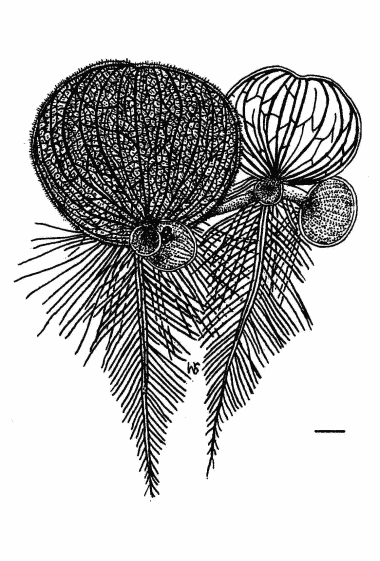
Kvacek, Z. (1995) Aquatic Botany 50(1):49-62.
"Limnobiophyllum Krassilov includes fossil free-floating stoloniferous plants each with one or two sessile suborbicular to reniform leaves of different size as well as numerous simple and one or two longer branched roots on a reduced main stem. The venation consists of campylodromous curved primaries, up to 14 in number, among which irregular reticulate veins of higher orders can be preserved. There are no signs of lateral pouches characteristic of the Lemnaceae. However, aerenchyma and pigment cells are well developed in Limnobiophyllum. Two species are recognized - Limnobiophyllum scutatum (Dawson) Krassilov (latest Cretaceous to Oligocene of western North America and Palaeocene of East Asia) and Limnobiophyllum expansum (Heer) Kvacek, comb. n. (Miocene of Europe). Turion-like bodies are associated with L. scutatum. No fruits have been found in connection, but numerous isolated ribbed seeds are associated with L. expansum. They resemble some Araceae and also Lemna L. and Spirodela Schleid. Such seeds are known as Lemnospernum Nikitin from the Tertiary of Eurasia. Limnobiophyllum resembles in some respects Spirodela, but it is larger and the roots and the habit are more like young plants of Pistia L. (Araceae). It differs from Hydromystria Mey. (i.e. Limnobium Rich.) by venation, root system and habit; the Lemnaceae, although similar, differ by lateral pouches of leafy fronds and the lack of branched roots and higher-order veins. Limnobiophyllum is considered as an extinct link related to Pistia (Araceae), from which Spirodela (Lemnaceae) may have evolved by reduction."

The fossil monocot Limnobiophyllum scutatum: resolving the phylogeny of Lemnaceae
RA Stockey, GL Hoffman and GW Rothwell, (1997) American Journal of Botany, Vol 84: 355-368.
"More than 200 specimens of Limnobiophyllum scutatum (Dawson) Krassilov have been recovered from lacustrine claystones in the Paleocene Paskapoo Formation near Red Deer, Alberta. The plant was a floating, aquatic angiosperm with helically arranged, ovate leaves attached in small rosettes. Rosettes are interconnected by stolons and bear simple adventitious roots as well as larger branching roots that appear to have vascular tissue. Leaves are pubescent, aerenchymatous, with 12-14 campylodromous primary veins that curve toward the apex, joining a fimbrial vein, often an apical notch. Staminate flowers with two, four-loculate stamens, are borne in the axils of second leaves. Anthers contain monoporate, globose, echinate pollen, 20-25 µm in diameter. The pollen wall is 0.8 µm thick, with a homogeneous foot layer, granular to slightly columellate infratectal layer and an echinate tectum. Pollen most closely resembles the sporae dispersae genus Pandaniidites Elsik. The completeness of L. scutatum has allowed for its inclusion in a numerical cladistic analysis to resolve relationships among taxa of the Lemnaceae, Pistia, and selected genera of Araceae. Results of the analysis indicate that the Lemnaceae plus Pistia form a monophyletic group within the Araceae."