
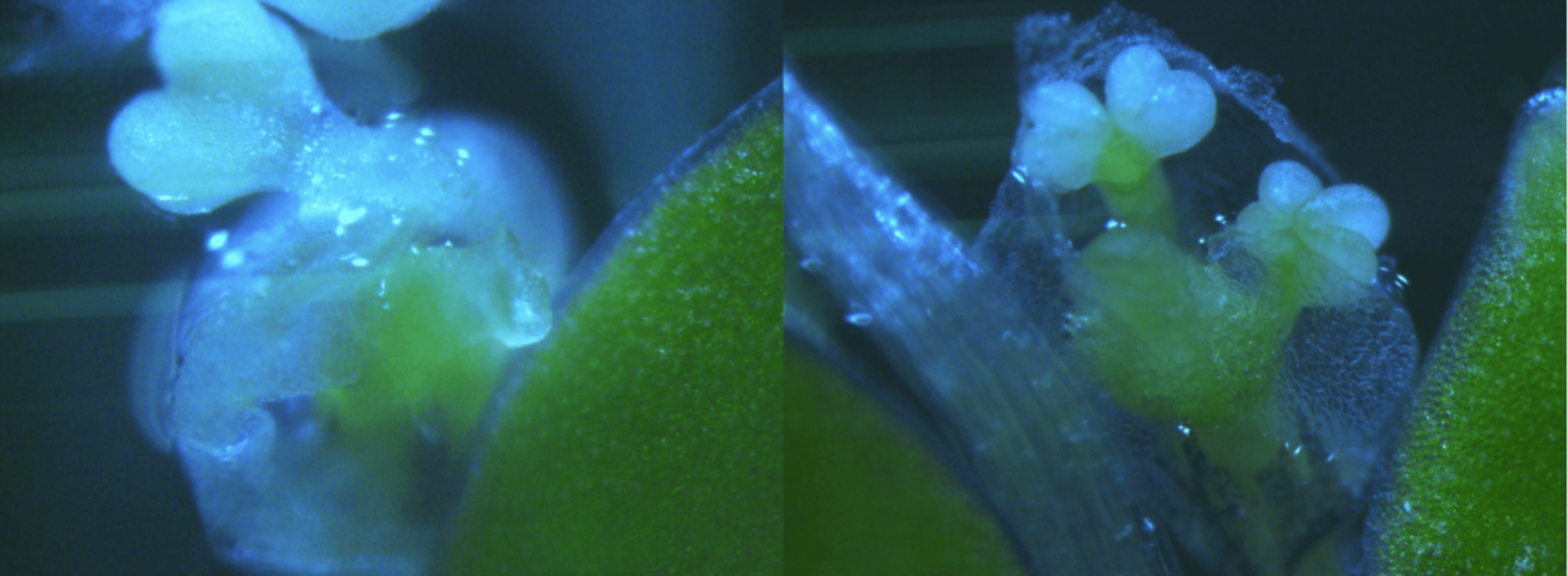
The Lemnaceae, or duckweed species have a very unusual growth strategy, often staying in a vegetative state by clonally budding. This offers them the fastest growth rates of the flowering plants, which is great for completely covering small ponds and outcompeting other aquatic plants, but it comes at a long-term cost of low diversity. Flowering, while much slower in producing a daughter frond, is crucial for adapting to changing environments or evolving alongside pathogens and herbivores. While very rare in nature, flowering is often seen at a certain time of year, or as a stress response when a clonal population needs genetic diversity. Since duckweeds are clonal, there’s also a fair chance that all nearby duckweeds are clones, resulting in a self-pollination between clones. There are a few mechanisms they use to encourage cross-pollination between different strains.
Many of our flowering protocols to study the effects in the lab were developed from 1960-1990, and most of the strains used have been lost, yet some work like Slovin and Cohen’s research on L. gibba G3 has been recreated. Our current understanding of flowering is fairly limited in terms of which species and strains flower, let alone have breeding protocols for. The findings below are not exhaustive, as new research comes out each year.
To flower or not to flower?
Each duckweed species strikes a trade-off between growth and flowering, and even self-pollination vs cross-pollination, to adapt to its specific environment. In Lemna aequinoctialis, strain Nd, was found to develop the anther and pollen before the pistil, which allows time to promote outcrossing before self fertilization. However, Shiga et al. (2024), found 6 other Lemna aequinoctialis strains where the pistil, develops before the anther and pollen, similar to Lemna minor and gibba, and 5 Lemna aequinoctialis strains where the male and female portions develop at the same time, which makes self-fertilization quite likely. Interestingly these simultaneous strains were able to self-fertilize and produce seed, while the strains with staggered development didn’t produce fruit or seeds, suggesting that certain strains were adapted to promote self-fertilization or outcrossing. Bear in mind though, that these timing mechanisms minimize the chance of a flower pollinating itself, but won’t make a difference if it’s surrounded by clones of itself.
Most plants are classified as long, neutral or short day-length flowering, with a specific day length corresponding to a certain time of year, which helps synchronize cross-breeding. With duckweed species however, we’ve seen variation in flowering response to day length between strains of the same species. Lemna aequinoctialis Nd, for example, was found to flower after growing in short days.
Each plant species has a different network of signals and genetic mechanisms coordinating to make a flowering go or no-go decision. In addition to day length, plant age, and stress responses, frond density and culture age may influence flowering. Wolffia microscopica is peculiar because, as Professors Appenroth and Sree described, it grows in seasonal ponds in northern India and Bangladesh, which dry out each year, meaning only the seeds survive. This partially explains why they often flower compared to other duckweed species. One protocol to see consistent Wolffia microscopica 2005 flowering was to grow them in an old and dense culture in one media, and then transfer them at a low density to a plate with a different media. This sudden change in culture density, and abundance of nutrients triggered a flowering response. Despite the need to set seeds to survive the winter, one strain had viable pollen, but wasn’t able to self pollinate, which could be due to culture conditions or self-incompatibility, a mechanism where a plant can’t pollinate itself or clones of itself. Self-incompatibility has been gained and lost dozens of times in plant evolution, and in duckweeds would mean the difference between the majority of flowers being self-pollinated by clones, or the risk that many flowers would never produce seeds, especially in a pond with only 1 strain in it.
Flowering as survival mechanism
Flowering is a great survival strategy to conditions like dehydration, where a seed will survive till better times, or when fungal pests are threatening a clonal population that shares the same defense mechanisms. Because of this, researchers have been using the stress hormones salicylic acid and jasmonic acid to induce flowering responses in several genera of duckweed species. Spirodela polyrhiza and oligorhiza, Lemna turionifera, and a few other species have a second dormancy strategy, where a dense frond, or a turion, a starch and anthocyanin rich tuber-like organ, sinks to the bottom of the pond, usually to wait out a winter freezing on the surface, or a nutrient deficiency, and then uses the starch to fuel the regrowth of new fronds in better conditions. Having both a sexual and asexual dormancy strategy may lead certain strains to flower very rarely if their environment favors turion formation.
Spirodela polyrhiza grows on all continents except Antarctica, originating in South East Asia, and spreading out to the Americas, India, and Europe. A recent genetic analysis shows that flowering and genetic diversity is highest in Asia, while expansion into newer territories favors asexual growth, since new variants are often out-competed by their numerous clonal neighbors (Wang et al. 2024). The study also found that Spirodela was one of the least diverse plant genomes, with a low mutation rate, infrequent flowering, and evolutionary selection favoring more asexual growth. This tracks with the relatively low flowering rates seen across the genus, especially in the more recently expanded European and American population. While strains 9509 and 7498 from these populations flowered, at 1% and 10% respectively, in response to salicylic acid, there were a fair number of aborted or improperly developed flowers in the stress condition (Fourounjian et al. 2021).
Frequency of flowering is species-dependent
While Wolffia microscopica flowers often, and Spirodela polyrhiza flowers rarely, Lemna minor appears to be somewhere in between, with several strains displaying moderate flowering rates after salicylic acid exposure. Several laboratory protocols developed in the Messing lab provide examples of male sterility, where stamens grew, but the anthers did not dehisce to release their pollen. These developmental defects might be due to temperature, media, or stress from the hormonal response.
Lemna gibba G3 is known to flower relatively easily, and produces complete flowers with the pistil developing before the anthers. It also produces viable pollen, and even fruits and seeds. These protocols, an available genome, and a number of previous studies make it a great model to study the whole sexual life cycle.
We don’t have all the puzzle pieces yet, but researchers are starting to build a picture of the way each species in the family uses signaling pathways determining flowering, turions as an alternative, pistil and anther developmental timing, self-incompatibility, and other adaptations to fine tune their flowering strategy for their environment and likelihood of cross breeding with different strains. While their lifecycle is very different from annual or most perennial plants we’re familiar with, each of these species is striking a balance between short term benefits of rapid asexual growth and the long-term need for genetic diversity.
Flower morphology
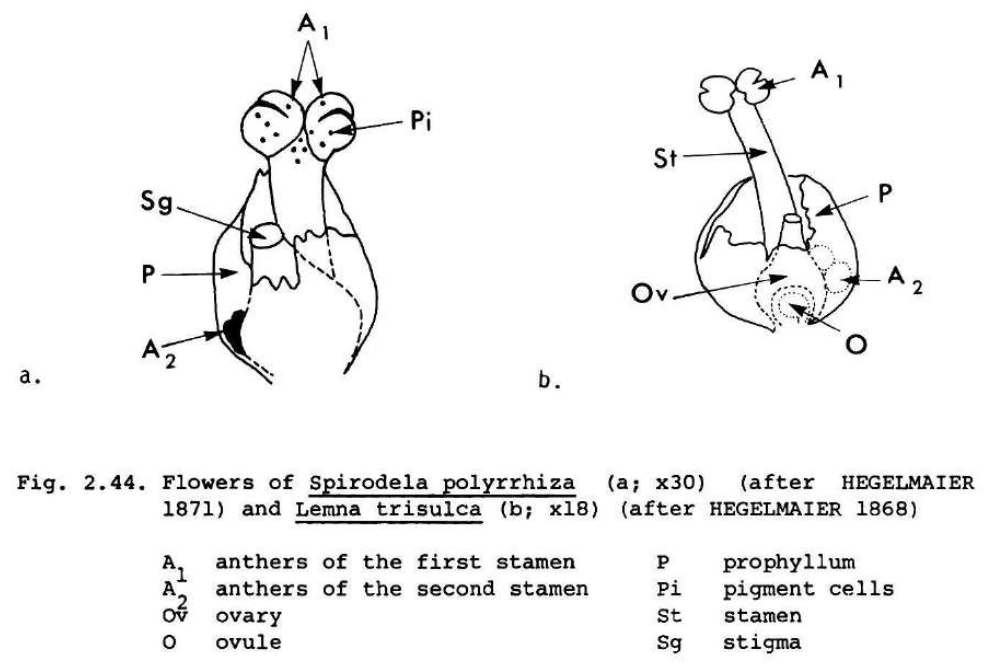


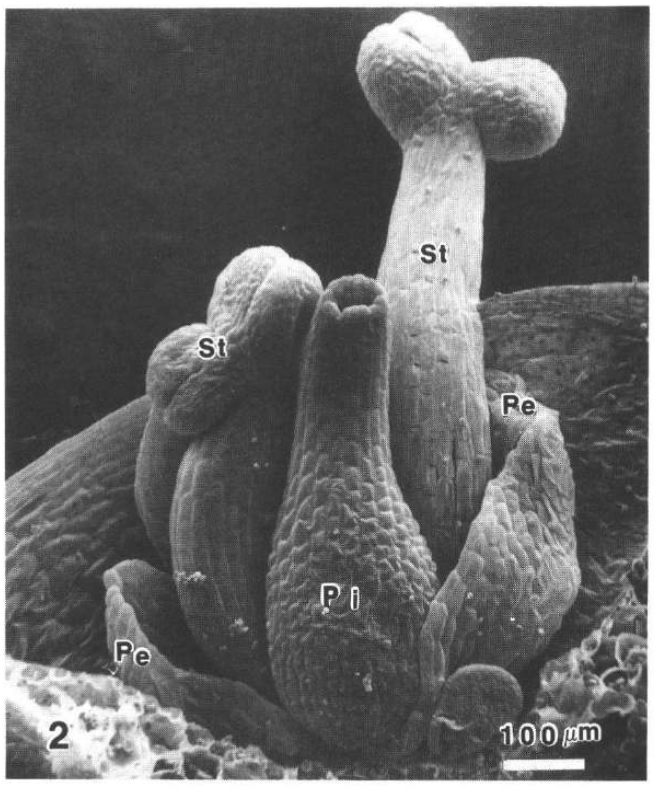
Written by Paul Fourounjian and Ewout Crombez